MLOps and ML Engineer Resume Format
An MLOps or ML engineer resume should show models running in production: pipelines, serving, monitoring and retraining, each with a latency, cost or accuracy number. Lead with experience; keep it to one page.
The layout: Compact
The Compact layout fits a dense stack (training, serving, infra, LLM tools) and two jobs with four bullets each on one page, without shrinking the text.
Sections, in this order
Summary
One or two lines that place you between data science and platform engineering, since "ML engineer" means different things at different companies.
Experience
Hiring managers want proof a model you touched served real traffic. Lead each bullet with the pipeline or service and end with latency, throughput, time saved or a metric.
Technical Skills
Group by ML, MLOps tools, serving and infra so a reader sees you cover the whole path from training to production.
Projects
A self-hosted RAG service or an evaluation setup shows current work with LLMs, which many Indian ML job posts now ask about.
Education
Below experience once you have two or more years. Keep the branch and CGPA; drop coursework.
Certifications and Writing
A cloud ML certification and a few technical blog posts are small but useful signals. Keep it to two or three lines.
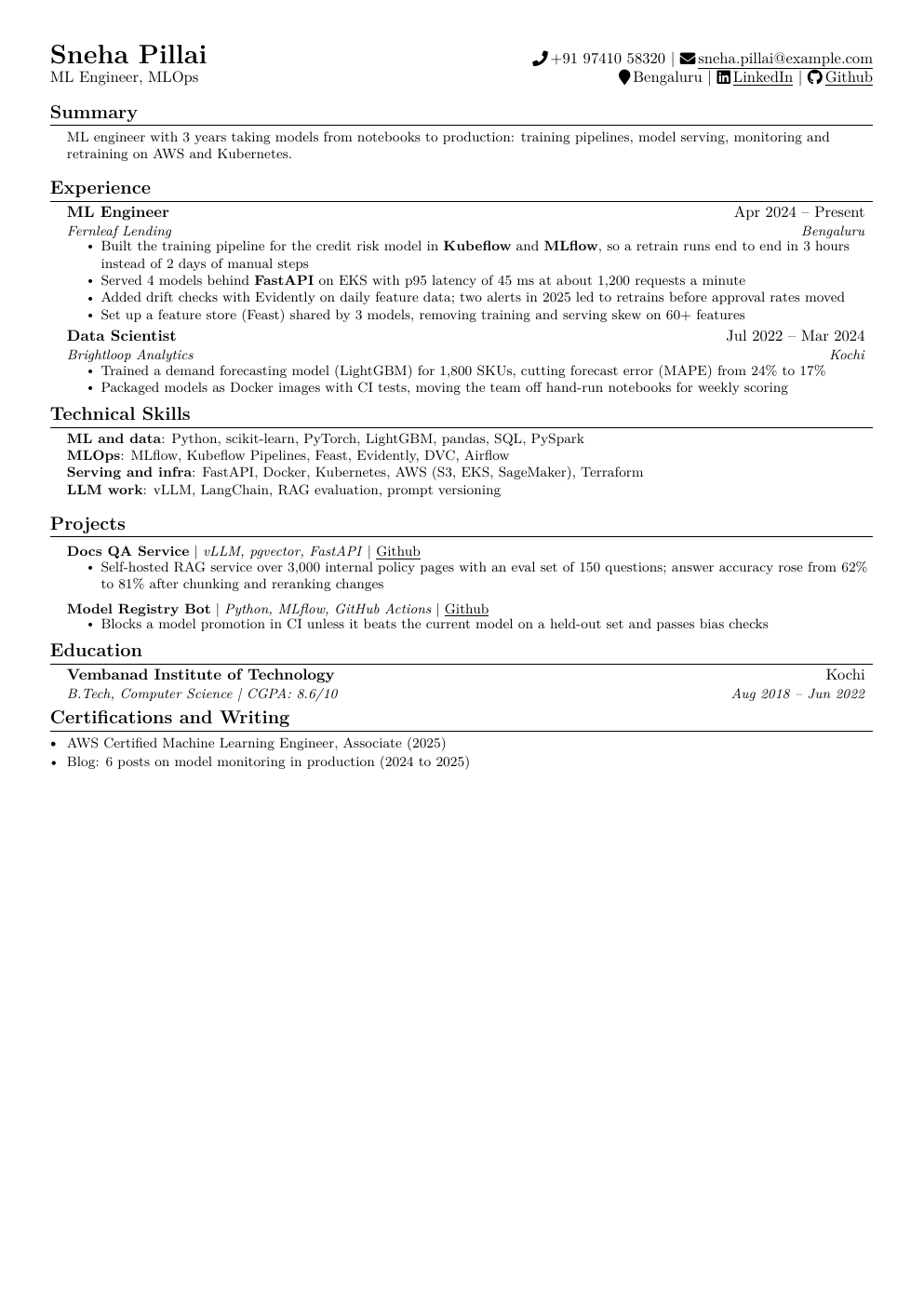
Skills to list, grouped
- ML and data
- Python, scikit-learn, PyTorch, LightGBM, pandas, SQL, PySpark
- MLOps
- MLflow, Kubeflow Pipelines, Feast, Evidently, DVC, Airflow
- Serving and infra
- FastAPI, Docker, Kubernetes, AWS (S3, EKS, SageMaker), Terraform
- LLM work
- vLLM, LangChain, RAG evaluation, prompt versioning
List only what you could answer interview questions on, and match the words the job description uses.
From a weak bullet to a strong one
- Before
- Deployed machine learning models to production.
- After
- Served 4 models behind FastAPI on EKS with p95 latency of 45 ms at about 1,200 requests a minute.
- Before
- Built an ML pipeline for model training.
- After
- Built the credit risk training pipeline in Kubeflow and MLflow, so a retrain runs end to end in 3 hours instead of 2 days of manual steps.
Applying in India
- Many ML roles in India are at GCCs and fintech or lending companies with strict data rules. Describe the model and the result, never customer data or the client by name.
- If you are moving from data analyst or data scientist to ML engineer, keep the earlier role but write its bullets around packaging, testing and scheduling models.
- Put a GitHub link in the header. For ML roles, a repo with a Dockerfile and a README that runs is worth more than a Kaggle notebook.
- State your notice period on Naukri and LinkedIn. Many ML openings in India want 30 days or less, and some buy out longer notice.
- Leave out an "Interests: AI, deep learning" line. Everything else on the page should already show it.
Mistakes to avoid
- Listing accuracy with no baseline. "94% accuracy" means little; "from 88% to 94% over the previous model" means something.
- Only notebook projects, with nothing deployed, versioned or monitored.
- Naming every LLM framework you have read about. List what you have shipped or evaluated.
- Mixing research and production bullets so the reader cannot tell which models went live.
Start from this format, then fit it to each job
Fill in a simple form or import the resume you have, and Shortlist lays it out in the Compact template. Paste a job description and the AI suggests changes using only what is in your resume, and you keep the ones you like. Building your resume is free.
Build my mlops and ml engineer resume