Cloud and DevOps Engineer Resume Format
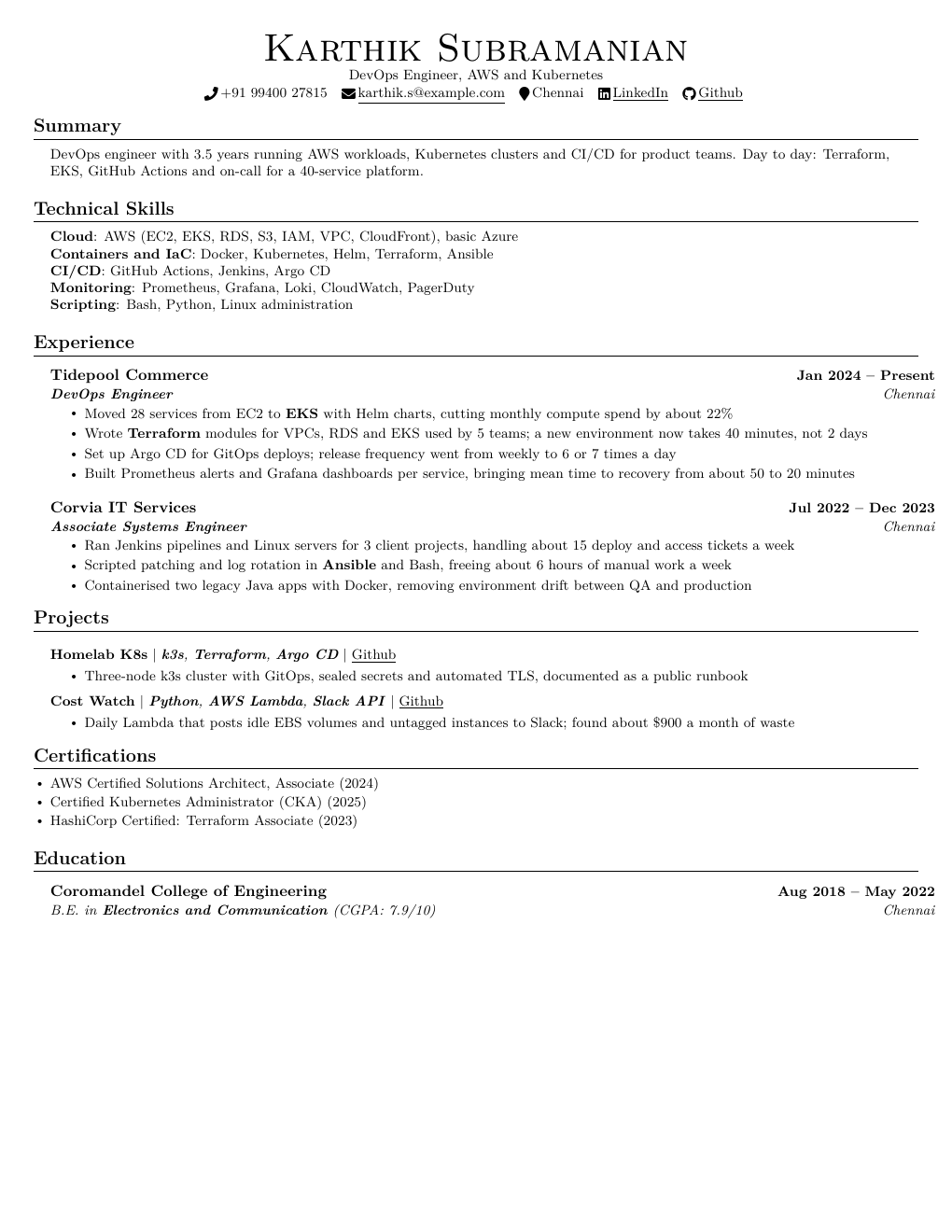
A cloud or DevOps engineer resume should open with a short summary and a grouped tools list, then experience with numbers on cost, deploys and uptime. Keep it to one page up to about five years.
The layout: Developer
The Developer template keeps the dense, single-column tech layout recruiters expect and puts GitHub in the header with an icon, which matters when you have Terraform or homelab repos to show.
Sections, in this order
Summary
Two lines that say your years, your cloud and your daily tools. DevOps titles vary a lot (SRE, platform, cloud engineer), so the summary tells the reader which one you are.
Technical Skills
DevOps job posts are mostly lists of tools, and recruiters and ATS match on them. Put the grouped list near the top so the match is obvious.
Experience
The core of the page. Each bullet should name the tool and the change it made: cost, deploy time, recovery time, tickets.
Projects
A homelab cluster or a small automation repo shows you work with the stack beyond your current job, especially if your employer is mostly on-premise.
Certifications
AWS, Azure, CKA and Terraform certifications are often listed in Indian DevOps job posts. A short list with years is enough.
Education
One line at the bottom. After three years of work, your degree branch matters far less than what you run.
Skills to list, grouped
- Cloud
- AWS (EC2, EKS, RDS, S3, IAM, VPC, CloudFront), basic Azure
- Containers and IaC
- Docker, Kubernetes, Helm, Terraform, Ansible
- CI/CD
- GitHub Actions, Jenkins, Argo CD
- Monitoring
- Prometheus, Grafana, Loki, CloudWatch, PagerDuty
- Scripting
- Bash, Python, Linux administration
List only what you could answer interview questions on, and match the words the job description uses.
From a weak bullet to a strong one
- Before
- Responsible for managing Kubernetes clusters and deployments.
- After
- Moved 28 services from EC2 to EKS with Helm charts, cutting monthly compute spend by about 22%.
- Before
- Worked on CI/CD pipelines using Jenkins.
- After
- Set up Argo CD for GitOps deploys; release frequency went from weekly to 6 or 7 times a day.
Applying in India
- If you are moving from a support or system admin role at a service company, title the bullets around what you automated, not the tickets you closed. Many DevOps engineers in India start this way, and that is fine to show.
- Mention your notice period and current location on Naukri, and keep the resume headline matching your Naukri headline ("DevOps Engineer, AWS and Kubernetes") so searches find both.
- Write cloud spend in the currency you were billed in. Most AWS bills are in dollars, so "$900 a month" is clearer than a rupee conversion.
- Product companies and GCCs in Bengaluru, Hyderabad, Pune and Chennai often ask for on-call experience. If you have done it, say so in one bullet.
- Leave out client names under NDA. "A US retail client" is enough.
Mistakes to avoid
- A skills list with 40 tools and no bullet that uses any of them.
- Listing certifications you have not finished ("AWS SAA, in progress") above real work.
- Writing "maintained 99.9% uptime" with no detail on what you did to get it.
- Leaving out scripting. Bash and Python are expected; say what you automated with them.
Start from this format, then fit it to each job
Fill in a simple form or import the resume you have, and Shortlist lays it out in the Developer template. Paste a job description and the AI suggests changes using only what is in your resume, and you keep the ones you like. Building your resume is free.
Build my cloud and devops engineer resume